


How to Become a Better Athlete (Even During Injury Rehab)
Are you working your way back after an injury, or simply striving to become a better athlete?
Either way, you’re in the right place. Here you’ll find practical, experience-based insights and strategies to help you move forward, stay consistent, and elevate your performance. Let this article serve as a guide you can share with any athlete seeking direction and motivation.
Challenges such as injury, illness, or periods of stagnation should not be seen merely as obstacles – on the contrary, they can represent an opportunity for growth. Every athlete faces moments that require reflection and adaptation. Ask yourself: Which area of my performance or life can I improve right now? Choose one, and commit to it.
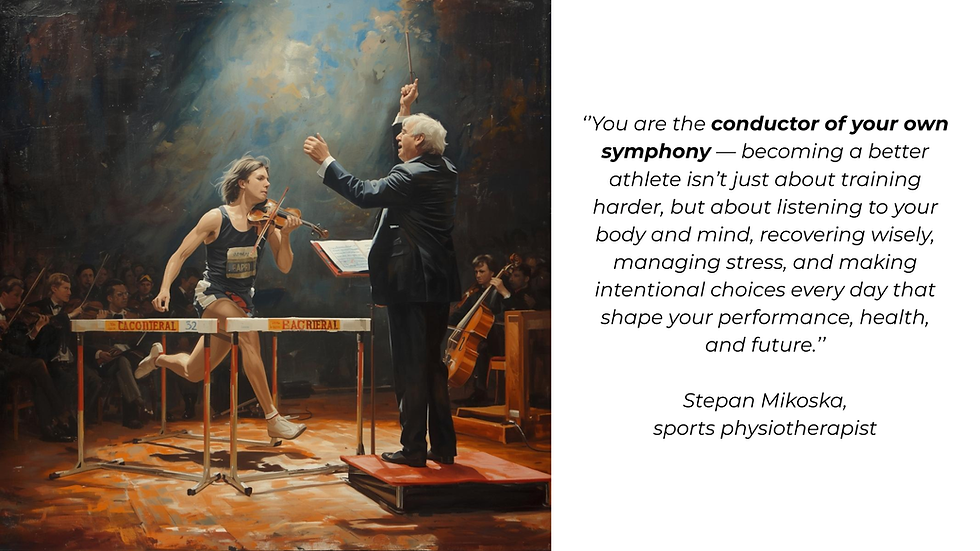
Always remember "You are the conductor of your own symphony"
Your training, your career, your life. The direction of the coming months is in your hands, not in the hands of your parents, coach, or anyone else. Your life and athletic career won’t last forever, so make the choices that move you forward.

1) Training Load, Body Awareness, and Communication
This is a topic I personally struggled with a lot during my years as an athlete — and when I say a lot, I mean a looooot. It’s a matter that goes beyond general health, sometimes leading to chronic overtraining syndrome and related issues.
Pay close attention to how your body responds to different training loads. Find the balance of intensity and volume that allows you to perform at your best, improve your training outcomes, and still recover properly — without chronic pain that could last for months or even years.
Keeping a training diary can help you track patterns, warning signs, and progress over time. Equally important is communication: always share honest feedback with your coach. This helps them adjust your program wisely and safely.
If you’re struggling, don’t forget to talk with your coach(es), physiotherapist, or doctor. They can guide and support you through these turbulent waters.
2) Mental Load, Psychological Preparation, and Stress Management
We all carry some mental scars from childhood, and these can influence our sporting journey. For example, anxiety can make muscles tighter, reduce flexibility, and disrupt coordination — all of which increase injury risk.
Research supports this. High muscle stiffness combined with stressful life events increases injury risk (Appaneal & Perna, 2014), and competition anxiety has been shown to raise injury risk in sprinters (Ford et al., 2017).

Taking care of your mental health is therefore not optional — it is a key part of athletic performance and longevity. There are many ways to support your mental well-being and prepare psychologically: working with a psychotherapist and/or mental coach, or dedicating time to self-development through books, educational content, or meditation practice. Each of these strategies can help you manage stress, improve focus, and build resilience both on and off the field.
3) Athlete's Sleep and Healthy Daily Habits
Sleep is the body’s most powerful recovery tool. It repairs muscles, consolidates learning, and balances hormones. Poor sleep slows recovery, increases injury risk, and lowers performance.
For me, chronic sleep problems were not just a minor issue — they were the number one reason I had to stop doing athletics altogether. Looking back, poor sleep wasn’t random; it was a signal from my inner space, a message from my body and mind asking me to listen more closely. I did not listen.
If you’re struggling with sleep, don’t ignore it or try to push through. See it as an invitation to slow down and reconnect with your body. Learning to listen to these signals is essential — and something I explore more deeply in a dedicated article about truly listening to your body (coming soon).
Lifestyle choices matter too. If you’re an athlete who treats every free Saturday as a reason to party, you might not even be reading this self-development article — and that attitude likely reflects how much you value your sporting career and personal growth.

4) Social Media Use and Other Addictive Behaviors
This topic deserves its own chapter, even though it fits under healthy habits. Over the past few years, we’ve seen how constant scrolling on Instagram, reels, and similar platforms increases restlessness and mental fatigue, both connected with regenerative potential of your body.
I know it’s hard not to scroll. But remember what my meditation teacher said: Everything we do, we do to avoid suffering. Being bored is uncomfortable, and putting the phone down can be difficult. I understand this deeply — I struggled with it for years. Take time for honest reflection: do you really need to use your phone right now, or not? Learning to be without it allows your body to enter a parasympathetic state, which is crucial for recovery after training.
Don’t steal your body’s ability to heal if you want to become a better athlete — and a better person. This applies not only to athletes, but to anyone dealing with social media or other addictions.
5) Nutrition, Hydration, and Supplements

Imagine renovating your house without tools, glue, or paint. That’s what performance looks like without proper nutrition and hydration. Your body simply doesn’t have what it needs to build, repair, and perform at its best.
It sounds simple — and we all know it — yet poor nutrition remains one of the main causes of athletic problems both acute and chronic.
Supplements can help fill gaps, but they are not a replacement for real food or water. If your only source of protein is a protein shake, that’s already a problem. Remember, some supplements are scientifically proven to support injury rehabilitation — such as increased protein intake and creatine — but they work best when combined with a solid nutritional foundation.
6) Recovery, Relaxation, and Regeneration
This is where the magic happens — not during training itself. Never forget that.
Proper recovery happens mainly during sleep and through genuine rest during the day (not scrolling on your phone, which does the opposite).
Work with a sports physiotherapist who has broad knowledge, not only of manual therapy and is ready to educate you about recovery. Use massage if it helps, and when dealing with injury, follow a structured rehabilitation plan with progressive loading. This is how your body heals and becomes stronger and resilient.
Relaxation during the day matters too. Chronic stress keeps your body in a constant fight-or-flight state, blocking full recovery and peak performance. Some stress is normal — we’re human — but chronic stress is harmful. Avoid adding unnecessary stress voluntarily, such as endless scrolling through reels.
Meditation is also worth mentioning. I’ve experienced its benefits many times myself. If you want to do something truly positive for your life and performance, consider attending a meditation retreat after your season. A skilled teacher — sometimes even a monk if you are that fortunate — can guide you deeply. Meditation strongly supports the parasympathetic nervous system, allowing you to train more with less stress on both body and mind.
7) Social Environment and Athlete's Relationships
The people around you strongly influence your performance, motivation, and recovery. If you find yourself in a toxic environment — for example, with a coach who constantly criticizes, shouts, or creates fear — remember that change is always possible.
Supportive teammates, friends, and family boost confidence, reduce stress, and help you stay consistent. Toxic relationships, on the other hand, drain energy, increase stress, and may even raise injury risk.
Surround yourself with people who encourage your growth — both on and off the track.
Summary
Becoming a better athlete is about more than just training harder — it’s about training smarter, caring for your body and mind, and making intentional choices in every aspect of your life. Balance your training load, prioritize recovery, manage stress, nurture your mental health, and fuel your body properly.
Surround yourself with supportive people, limit unnecessary distractions, and use setbacks as opportunities to grow. Remember: your athletic journey is a reflection of the choices you make daily. Embrace the process, listen to your body and mind, and commit to continual improvement — both on and off the field. Your future self will thank you.
With love,
Your sports physiotherapist,
Stepan Mikoska


This was such a valuable read, thank you for sharing! The section on personal growth during recovery really resonated with me; I've been going through a similar phase with my own training setbacks. It's encouraging to see that improving yourself isn't just about the physical gains, but also the mental fortitude you build. I completely agree with the perspective you're offering on continuous improvement https://www.deakin.edu.au/ It’s true, what makes someone truly exceptional in their pursuit of becoming better often hinges on the specific circumstances they find themselves in. For instance, adapting training strategies while injured requires a unique kind of resilience that’s different from pushing through a tough workout when healthy. This nuance is so important. It makes me wonder…
This is such a fantastic breakdown of how to approach self-improvement, especially when dealing with setbacks. The long-term implications of focusing on incremental progress are absolutely worth a separate discussion, and I appreciate the depth you've gone into here. It’s precisely the right level of detail to make it actionable without being overwhelming. Honestly, my team would absolutely love this perspective on becoming better https://www.utas.edu.au/ My own firsthand results with this mindset speak louder than any analysis I could offer. It’s funny, I’ve been trying to articulate this very approach for ages, but you’ve captured it perfectly. I didn’t realize how much I needed this until I read it, so thank you for that! It's incredibly motivating to see it…
This post really resonated with me, especially the idea of focusing on growth even when facing setbacks. It's so true that the next step after acknowledging where you are is always exploring how to become better, deeper. I actually picked up a book on personal development during a particularly tough period in my life, and it was precisely the lifeline I needed to keep moving forward https://www.auspayplus.com.au/ Your honest approach to discussing personal growth, particularly how you covered the journey of becoming better, was incredibly refreshing and appreciated. I’ve just added the core concepts to my Notion board; it’s a system that helps me track progress and stay organized with my goals. This is definitely a must-read for anyone serious…